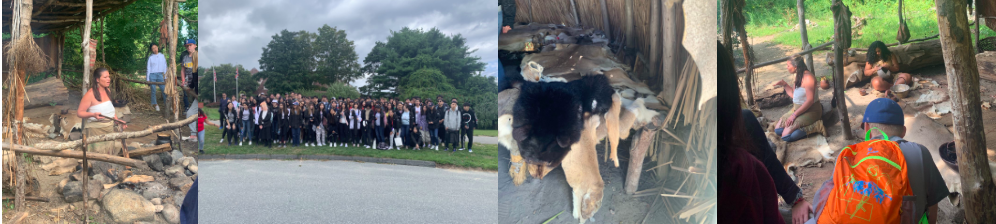
As the students start the academic semester, we organize a field trip to Plymouth Plantation in conjunction with their sociology of Boston. Through feedback from previous cohorts it has been suggested that this trip is extremely useful and a great cultural experience for the international students. When at Plymouth the students are able to interact with actors portraying Native American life.
“Learning consists of grasping an experience and then transforming it into an application or result” (Kolb, 1983). Our student’s task will include walking around the Plymouth Plantation and interacting with the actors and asking questions. As well as this, they have been instructed to find out interesting facts about the way that the pilgrims and Native Americans live. Having a real interactive conversation and visual stimulation will be extremely beneficial to our student’s especially as English is not their first language.
After doing further research on the benefits of field trips in higher education I found that “A field trip with a single focus will provide a potential impact to students’ cognitive skills, knowledge, interests, and future career” (Hutson, Cooper, & Talbert, 2011). Not only does the field trip have the listed benefits above but also it allows students to practice their conversational English and interact with someone rather than reading a traditional text.
When students return from the field trip they will be required to write and present the notes, they took about the different aspects of Plymouth in a reflection session. According to Behrendt and Franklin “Reflection occurs as the student talks about the experience, and abstraction occurs as the student thinks about the experience” (Behrendt & Franklin, 2014). This being said our students would be completing a reflection session and therefore solidifying their knowledge for the future.
Through going on this field trip and gaining an understanding of how important trips like these are to students and especially our international students. After seeing the positive results of the field trip i was able to gauge an understanding of why our department spend the proportion of their budget on this trip and how they decide which resources should be used when. This expansion of knowledge link’s with learning objective 1 (see appendix 1).
Appendix 1
1. Experience the environment of a commercial, public sector or social economy organisation and appreciate how needs are identified and how resources are acquired, allocated and used in order to achieve organisational objectives;
References
Behrendt, M., & Franklin, T. (2014). A Review of Research on School Field Trips. International Journal of Environmental & Science Education, 237.
Kolb, D. (1983). Experiential learning, experiences as the source of learning and development. Englewood Cliffs, New Jersey: Prentice Hall
Hutson, T., Cooper, S., & Talbert, T. (2011). Describing connections between science content and future careers: Implementing Texas curriculum for rural at-risk high school students using purposefully-designed field trips. Rural Educator,31,37-47.Open publish panel
 Abby Duncan